2022: How Does the Grass Grow?
1. I Can't Read 2. Servant of the People 3. Right In Two 4. Valentine's Day 5. The Informer 6. How Does the Grass Grow? 7. No Smoking Area 8. Swan Lake 9. A Better Future 10. Time 1. I Can't Read I can't read shit anymore I just sit back and ignore - "I Can't Read" (Tin Machine) For most of a decade from 2012 or so, I paid little attention to the news. It just seemed like noise, and that once I'd figured out a schema into which to fit all the information, very little of it changed my mind about anything. So I was living under a rock. In 2016 I was working at a school where we had a meeting and the principal mentioned a connection to a terrorist attack in France, I didn't know what he was talking about. 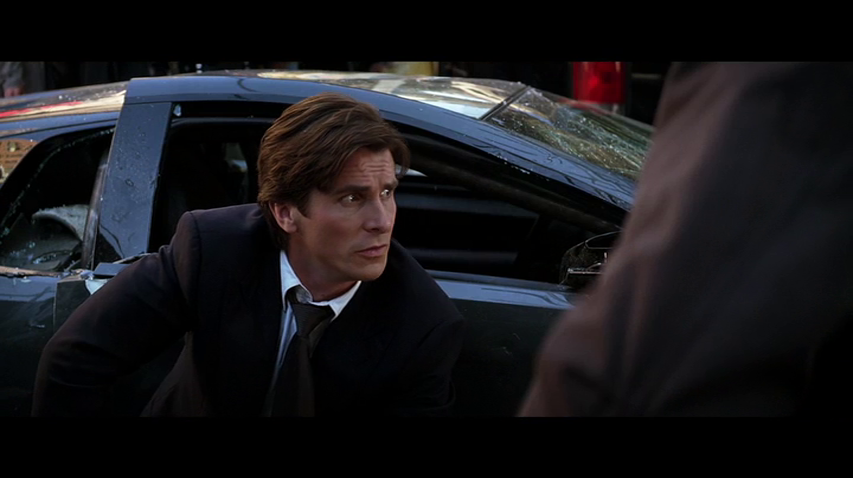
GORDON: That's a very brave thing you did. . . . You weren't protecting the van? WAYNE: Why, who was in it? GORDON: . . . You don't watch a whole lot of news, do you, Mr Wayne? (The Dark Knight) The news became a lot more interesting with the pandemic of course. An odd event to change things, one of necessary stillness. Beyond the health emergency, it has had indirect effects that aren't always attributed to it. For some of these, the causation is readily discernible. We were less productive during the pandemic, supply got squeezed, prices had to go up and there where the inflation comes from. This year I looked at my tax receipt — the item for defence — and thought: some of that money is being used to kill Russians.*** We're in a proxy war with Russia, and although it's hard to say the pandemic caused it, it probably made Russia's invasion more likely. Parts of the world we knew have been burned away, and out of this, as Sons of a Silent Age, we emerge into a world with fewer certainties at face value, but it isn't all bad — actually, apart from the many lost lives, the pandemic might have been mostly good for us. "Us" as the West. It's what I was thinking when I wrote "Sunday" last year. The raised white scar on my leg was this thing that wouldn't heal properly — its destruction by infection, though painful, is likely to lead to its replacement by a stable epithelial covering. I say "likely" because it macerated from underneath earlier this year, but good authority tells me it is certain to heal completely soon, and it looks that way. And the pandemic, though immediately awful, drew our enemies out. Potential threats have turned into known threats, at great cost to these dictators. It was better for them to make their moves now, as a result of the pandemic, mistiming badly, than when they might have been in stronger positions. One of them is Vladimir Putin, who sensed an opportunity. This year I have probably known more about events in Ukraine than Australia. I was very busy with a work project but to me, apart from being horrifying, the war has been necessary to keep an eye on because of its potential to escalate, and some aspects that I've found interesting in ways that most people might not. In particular, I was a bit miffed that a lot of the reporting assumed that the invasion was wrong. I didn't disagree, but thought that conclusion was one that the audience should come to for themselves. I was also intrigued by Volodymyr Zelenskyy's history in showbiz, and the TV show in which he portrayed a president of Ukraine, before assuming the office in reality — Servant of the People. And a performance of Hans Zimmer’s "Time" amid air raids caught my eye. "Time" is a track from the movie Inception, and my first thought was that Alex Pian was thinking of the unreality of the situation, reminiscent of much of that movie. It must have felt like the world was breaking. 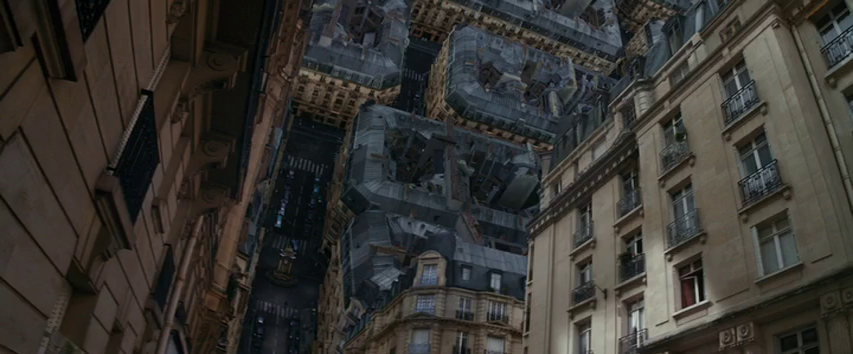
(Inception) But maybe that wasn't all?
Before becoming the actual president of Ukraine, Volodymyr Zelenskyy portrayed Vasily Petrovych Goloborodko ("Vasya") in a Ukrainian comedy, Servant of the People. Vasya teaches history and one of his students films him ranting about corruption. People like the video and elect him president. I haven't watched any kind of regular TV for almost twenty years, and ordinarily would never have checked out an obscure foreign comedic satire of politics. But with the man of the geopolitical moment in the lead role, I was interested enough to watch all three seasons. 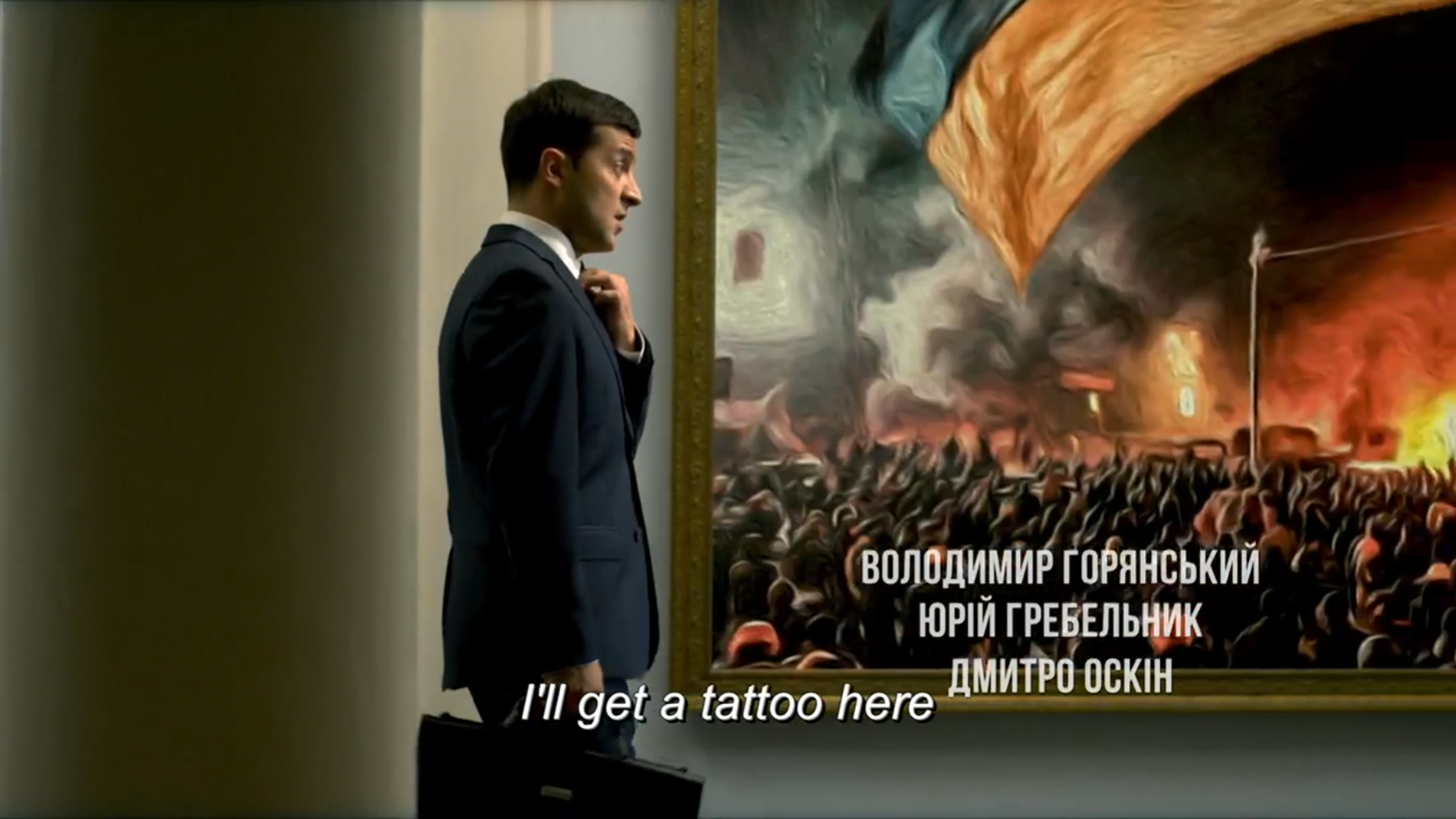
(season 2 version of the Servant of the People introduction) About the first half of season one introduces the characters and their context. It might be interesting as a light introduction to the Ukrainian system. Vasya works closely with Yuriy Ivanovich Chuiko, prime minister and a veteran who introduces him to the system. Yuri is somewhat reminiscent of Humphrey Appleby in Yes Minister / Yes, Prime Minister. He's helping Vasya, but also working against him, beneath a blanket of polished civility. Vasya finds it difficult to hire people he trusts for his government, and resorts to appointing his friends, including Sergey Viktorovich Mukhin as the minister of foreign affairs, and Olga Yurevna Mishchenko (his ex-wife) as head of the national bank of Ukraine (their central bank). These characters already have shared histories, so affairs of state become mixed with personal intrigues. Vasya and Olga argue about parenting their son, and tend to disapprove of each other's romantic ventures. Sergey handles foreign affairs by having affairs with foreigners (and pronouncing volcanoes). 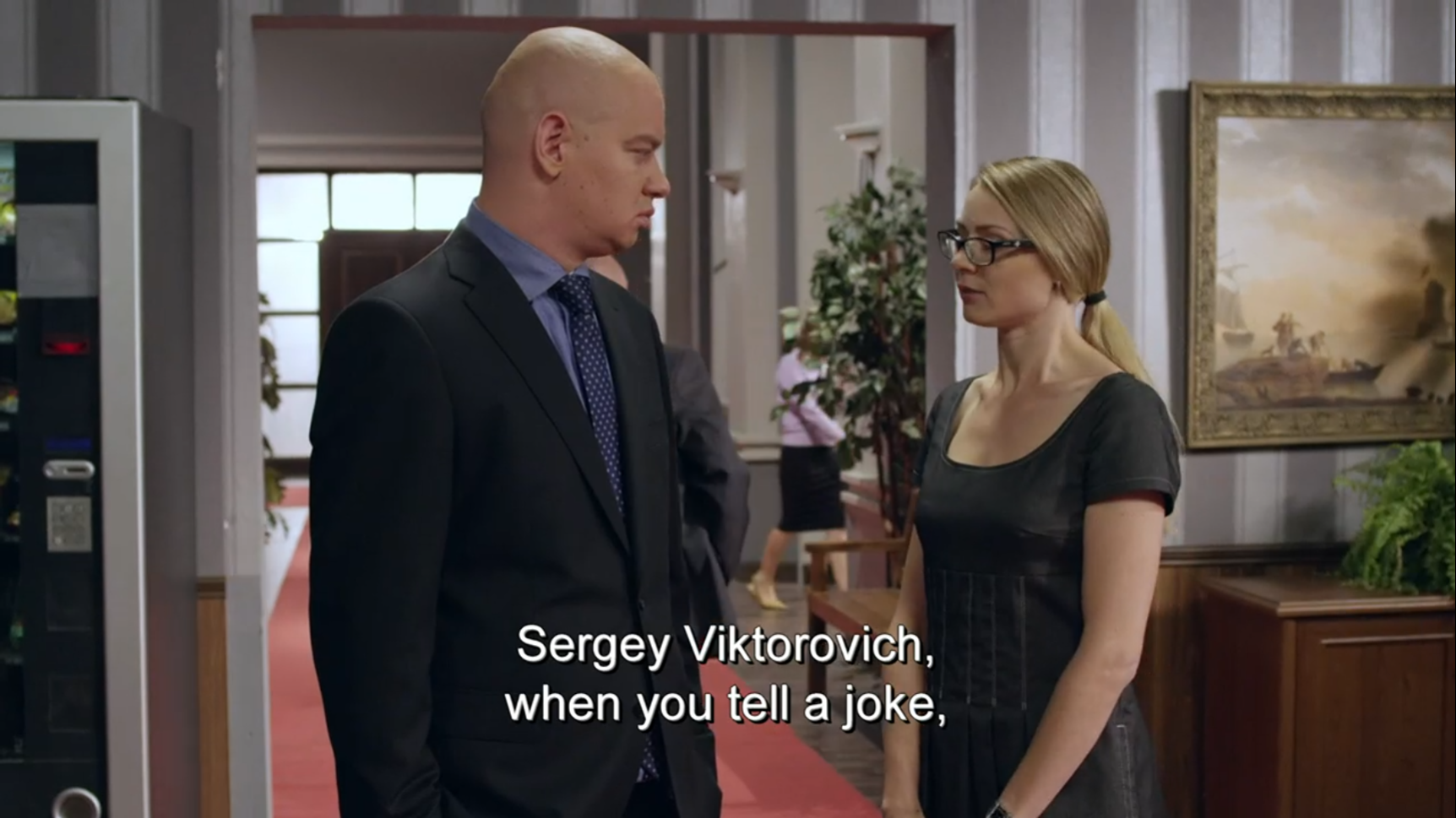
SERGEY: Are jokes allowed? OKSANA: Jokes? SERGEY: Yes, jokes, funny stories, banter. Humour, Oksana. OKSANA: Humour's fine. But not for you. . . . when you tell a joke, it takes us far too long to apologise afterwards. (Servant of the People S1E11) I didn't initially find this funny in the way that I would have expected a comedy to be — until episode 11 (Sergey's crude joke, Oksana's lame joke and the Dutch contingent). The dramatic aspect of the narrative is Vasya's fight against corruption. He's honest, but a comedy wouldn't work with a perfect lead, so he's "vulnerable" to the ladies, can't act when that would help him, and doesn't know when he's had enough vodka (but that leads to some cool dance moves in episode 17). Season 2 (subtitled "From Love to Impeachment") expands on Vasya's asymmetric contest with the oligarchs of Ukraine (Nemchuk, Mamatov and Roizman). A feature length cut was made, its trailer indicates that its scenes are drawn from about the first half of the season. I think it works pretty well. It's still funny, and the dramatic aspect is strong: Vasya learns to be deceptive because it's necessary, and there are shifting alliances and changing fortunes throughout the season. Episodes 8 to 13 are about a special operation on time bought with vodka, performed by a remote-controlled Yuri and Vasya's weaponised cakes. They're worth checking out because they're freaking hilarious. Season 3 (subtitled "The Choice") only has three episodes. It begins with Vasya in prison and Ukraine later splits into 28 independent states. Most of the characters from previous seasons make an appearance (there's basically a roll call in episode 3), but the only consequential character other than Vasya is Yuri. Yuri's character has evolved. In season 1 he is two-faced and in season 2 he is morally ambiguous, but in season 3 he is on Vasya's side. He might even have grown a conscience. 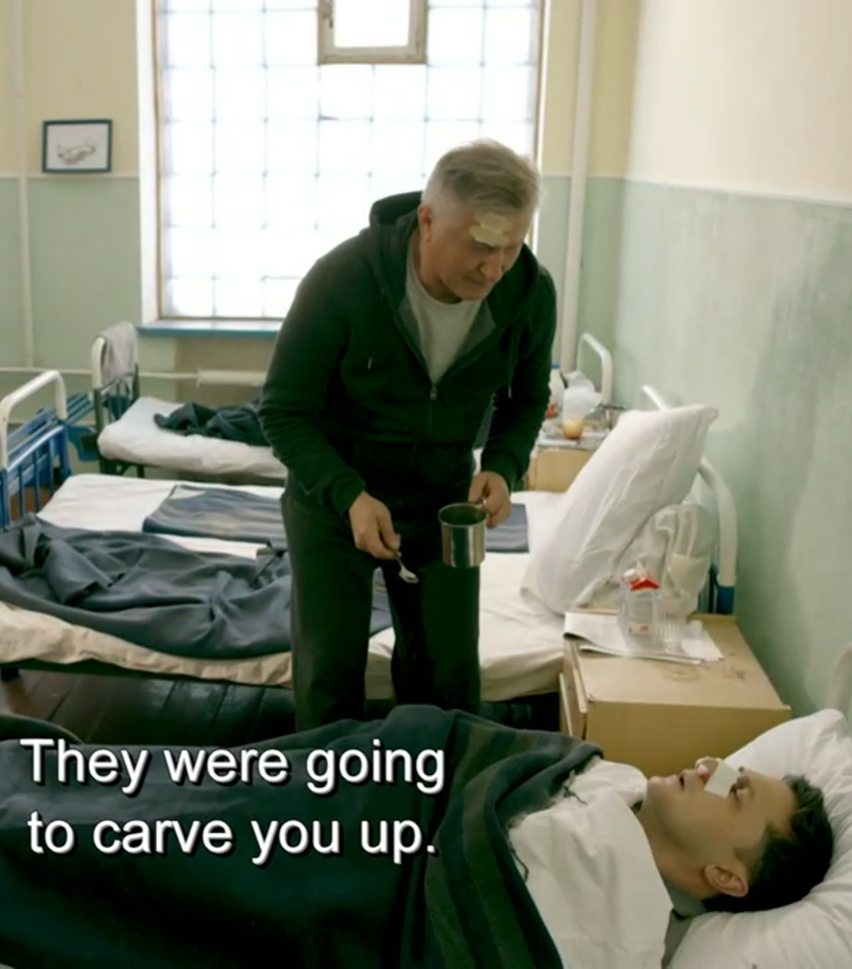
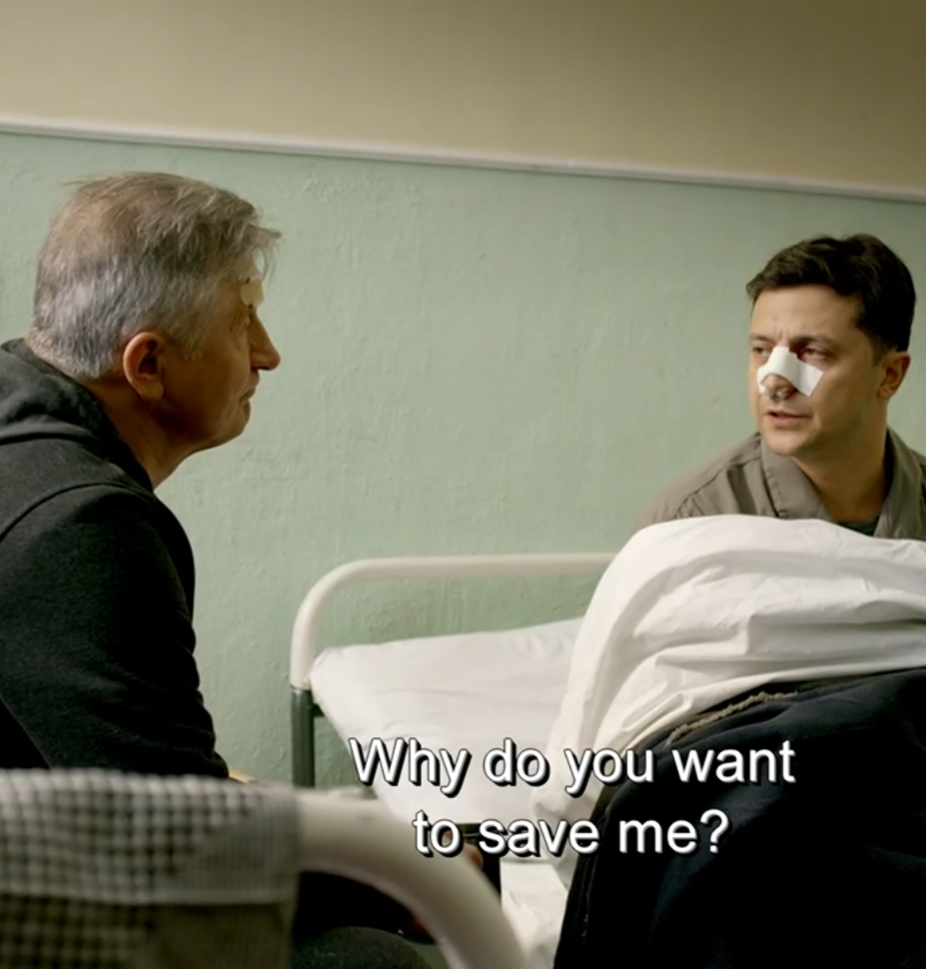
YURI: They were going to carve you up. . . . VASYA: Why do you want to save me? (Servant of the People S3E1) But he continues to believe that some level of corruption is unavoidable in government, to put Ukraine back together, while Vasya thinks that this would be a way to sew Ukraine back together with rotten threads and create a Frankenstein. The titular "choice" is one between Vasya's and Yuri's conflicting approaches to the problem. To be fair, season 3 seems underdeveloped, possibly because there are only three episodes. Maybe it was aborted with only enough work done for three episodes when Zelenskyy became president? It still managed to have something interesting to say. In light of Russia's invasion of Ukraine, the show is interesting on a number of levels. Zelenskyy's political party bears the name of the show, which basically became an advertisement for his presidency. As president, then, Zelenskyy was obligated to behave like Vasya. So it became a strange realisation of life imitating art. When I was watching, it seemed a little unreal that in one tab I would see Zelenskyy pretending to be president, and then in another tab he's be the actual president. I'd half expect one of the characters from the show to appear alongside him. The fictional Vasya is an idealist.
It's been said that as president before the war, Zelenskyy behaved like Vasya.
People tended not to doubt his honesty, but they wondered whether he was really up to the job.
Along with having served as a guide to how he would govern in peacetime, the show might even predict what Zelenskyy will try to do in future.
Because Ukraine faced an existential threat in the show, as it now does in reality.
It isn't why I watched, but I enjoyed the show, and it is the product of a culture, one that Putin wants to extinguish.
In prehistory, when our forbears were swinging through jungles, resources were limited and to survive, we needed to compete for those limited resources. This competition occasionally resulted in violent conflict . . . as it still does. Leaders got to be called strong and were admired for deeds that wouldn't work in today's world. 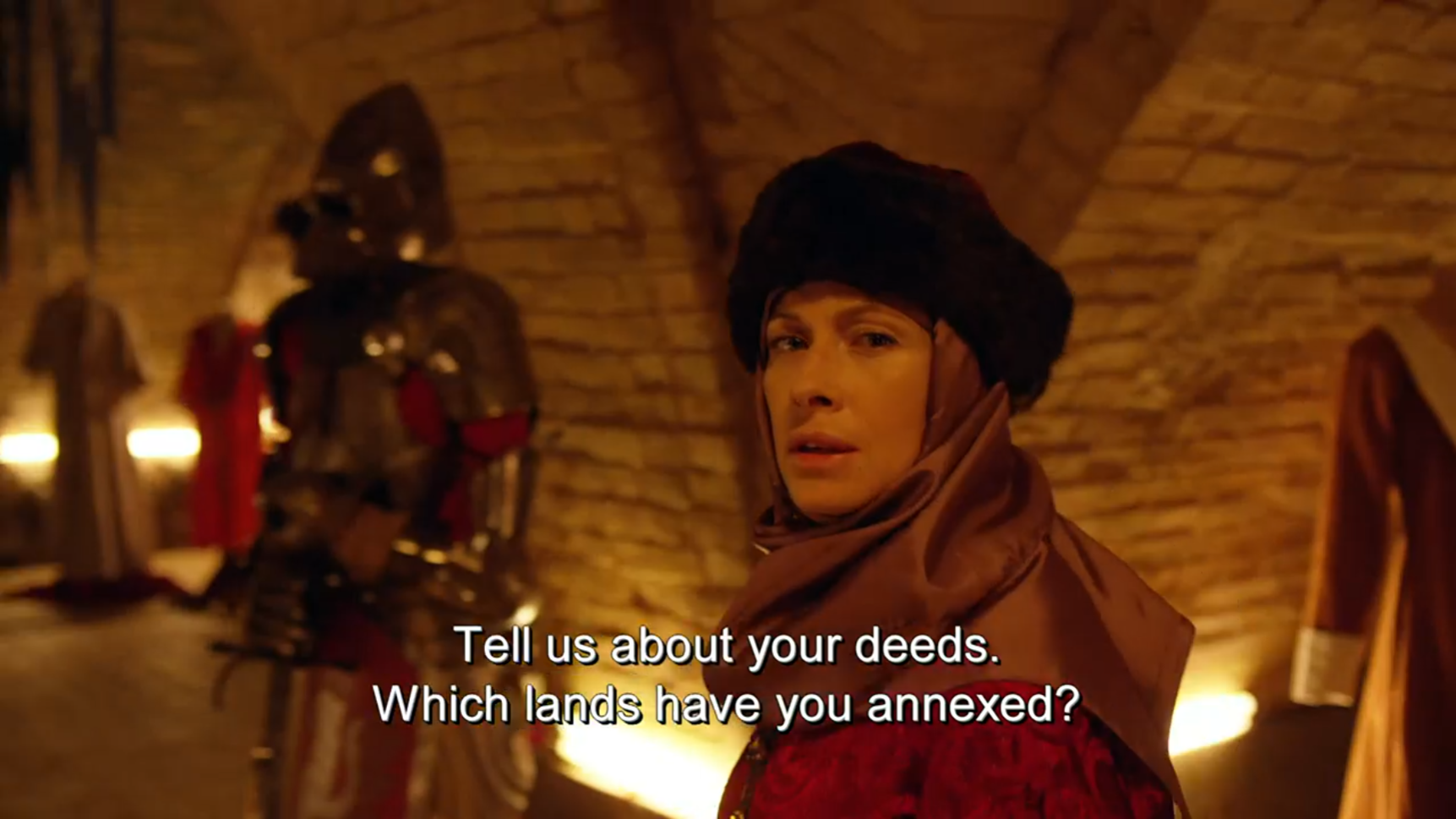
OLGA: Tell us about your deeds. Which lands have you annexed? Which nations have you conquered? Who did you impale on a stake? VASYA: I haven't done that. SKORIK: So you didn't do anything, you scoundrel? (Servant of the People S2E14) Competition that ensures only survival of the fittest isn't bad for a species or group that struggles for survival. Wars and the potential of war continue to drive innovation. But following industrialisation, our species isn't existentially threatened by scarcity of resources, so maybe we don't need violent competition anymore. To explore this possibility, we would ideally perform an experiment: start with two large groups of humans, make one of them fight amongst themselves while humans in the other group all get along. We watch and see which of the groups does better. The experiment was done in the centuries leading up to the 19th. During this time, Europe experienced the Thirty Years' War, Seven Years' War, and the Napoleonic Wars. After an expensive revolution, China got through most of this period ruled by a single dynasty, the Qing. Despite its higher population, China was repeatedly defeated in wars with Europeans in the mid-nineteenth century. 
SAITO: We are the last company standing between them and total energy dominance. And we can no longer compete. . . . The world needs Robert Fischer to change his mind. (Inception) So at least that recently, there's an indication that deadly competition accelerates progress. But in today's world, we have nuclear weapons. Deadly competition could escalate to nuclear war that sets human progress back by centuries. We still want to have competition, but managed competition that doesn't lead to war. To achieve this, we have rules. When countries become members of the United Nations, they agree to the UN charter, which tells them they cannot attack other members. And there are rules that come in the form of agreements on ways to manage disputes, arms limitations treaties and so forth. More than any other country since the Second World War, it is the United States that has guaranteed the growth and observation of these rules. Supposedly, America is the land of the free and is all about freedom, but I'd say it's more important that it enforces rules. The notion that America is some kind of empire or hegemon has long seemed nebulous to me. I suppose that after a gross oversimplification of global politics it might seem that way, but since the Cold War, the United States has only acted against credible or confirmed threats. Even the 2003 invasion of Iraq was based on a credible threat, and was not a clear violation of the rules, which were collectively ambiguous. Not saying that was a smart move, but Hussein certainly wanted to develop the weapons he was feared to have, even if he didn't have them yet. 
SAITO: But in my dream, you play by my rules. (Inception) Any criticisms of the US should be weighed against the alternative to the rules they uphold more than anyone else.
We've had a taste of that, courtesy of the pandemic.
Autocrats have regarded the pandemic as an opportunity to challenge the rules.
Xi Jinping attempted to establish uncontested dominance of the South China Sea, invade India and start a trade war with Australia.
How did all that work out for him?
Fail. Fail. Fail.
But now we've been reminded of what the alternative to US hegemony, if we were to accept that there even is such a thing, might look like.
Whenever the topic of Russia came up in the last decade or so, and how it was resurgent and maybe we should be worried, I was dismissive. They have an economy about the size of ours (Australia's), and their bark is worse than their bite. Failure in Ukraine reinforces that assessment. Perhaps the most important of Putin's stated reasons for his invasion is the potential for Ukraine's membership of NATO. He claims that the expansion of NATO to Russia's border is a threat to its security, which is nonsense because NATO is a defensive alliance. NATO isn't actively trying to recruit countries, there are countries that want in. Putin has said that the collapse of the Soviet Union was greatest geopolitical catastrophe of the Twentieth Century. 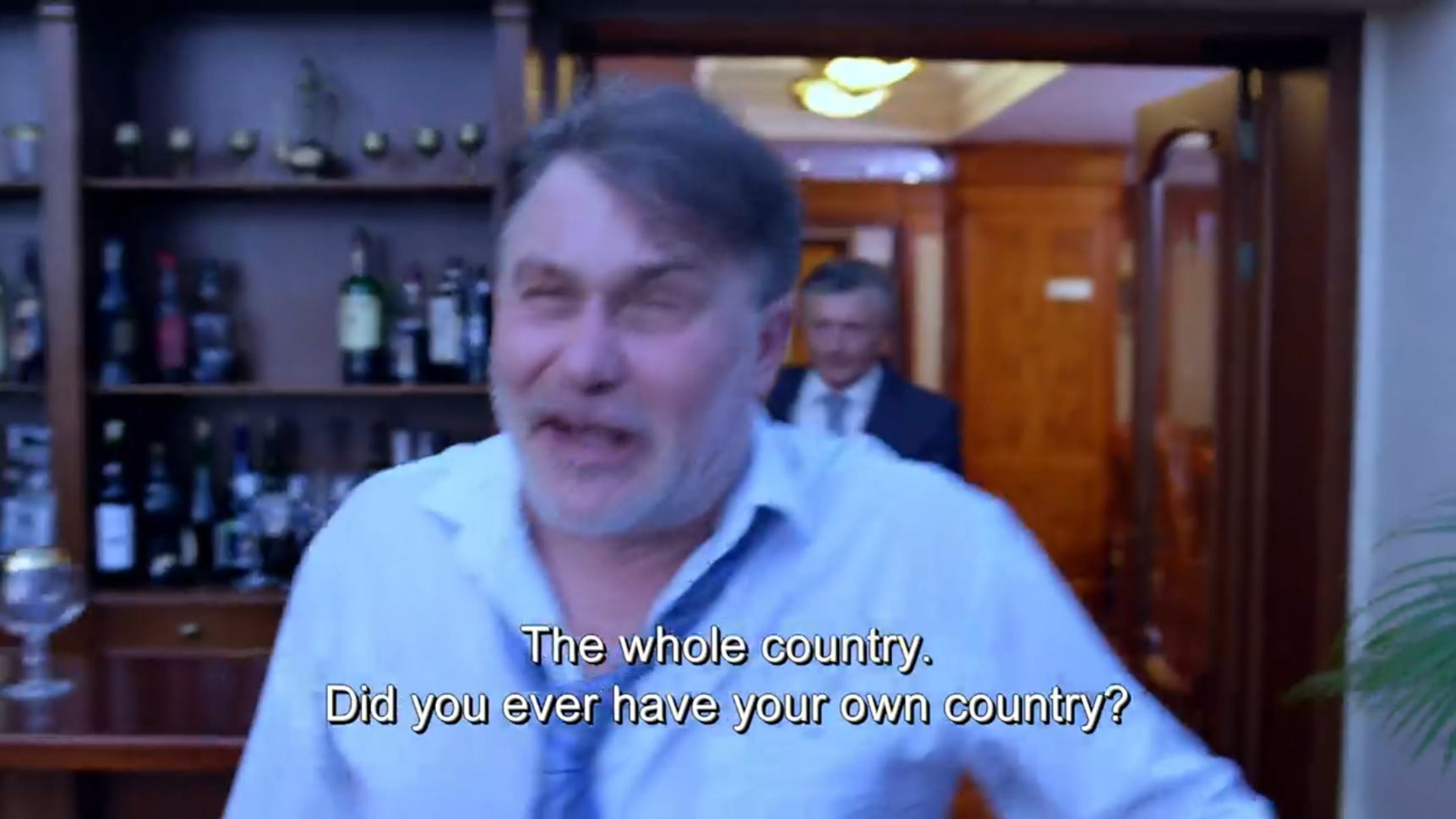
YURI: I do understand. EX-PRESIDENT: No, you don't. They stole the country from me. The whole country. Did you ever have your own country? (Servant of the People S1E4) Putin's actual motivation is more about restoring the Soviet Union, and perhaps more interestingly, about adding more distance between Russia's western border and Moscow. That reason actually would make some sense, because invasions of Russia by Napoleon and Hitler both failed because after invading in the summer, it would take them long enough to fight their way to Moscow that they would be frozen by the Russian winter. However many, or which, of these were actual motivations, Putin's living in the past. It's clear from the way he talks about history that he admires Russia's expansionist past. But his is a dream that doesn't work in a world with rules. Putin's invasion of Ukraine violates both the UN charter and the Budapest Memorandum. This challenge to the rules seems to have been timed to take advantage of the remaining pandemic uncertainty before complete recovery, and according to Macron, Putin's isolation during the pandemic led him in that direction as well. He also wanted to act before Europe no longer needed Russian energy, and he was emboldened by the US withdrawal from Afghanistan. We also know that he hesitated a few times before sending his army in, so he wasn't sure. It's possible, then, that if there hadn't been a pandemic, the balance would have swung against invasion in his mind, and he wouldn't have done it. At least, not then. It's been on his mind for a while, so it's possible that he was always going to do it eventually. 
COBB: What is the most resilient parasite? A bacteria? A virus? An intestinal worm? . . . An idea. Resilient, highly contagious. Once an idea has taken hold in the brain, it's almost impossible to eradicate. (Inception) 5. The Informer And I still don't know What we were looking for But it wasn't you - "The Informer" (The Next Day Extra EP) At the beginning of the invasion, Putin sent special forces to Kyiv to take out Zelenskyy. Maybe they asked for directions. If so, they apparently didn't find any useful informers. 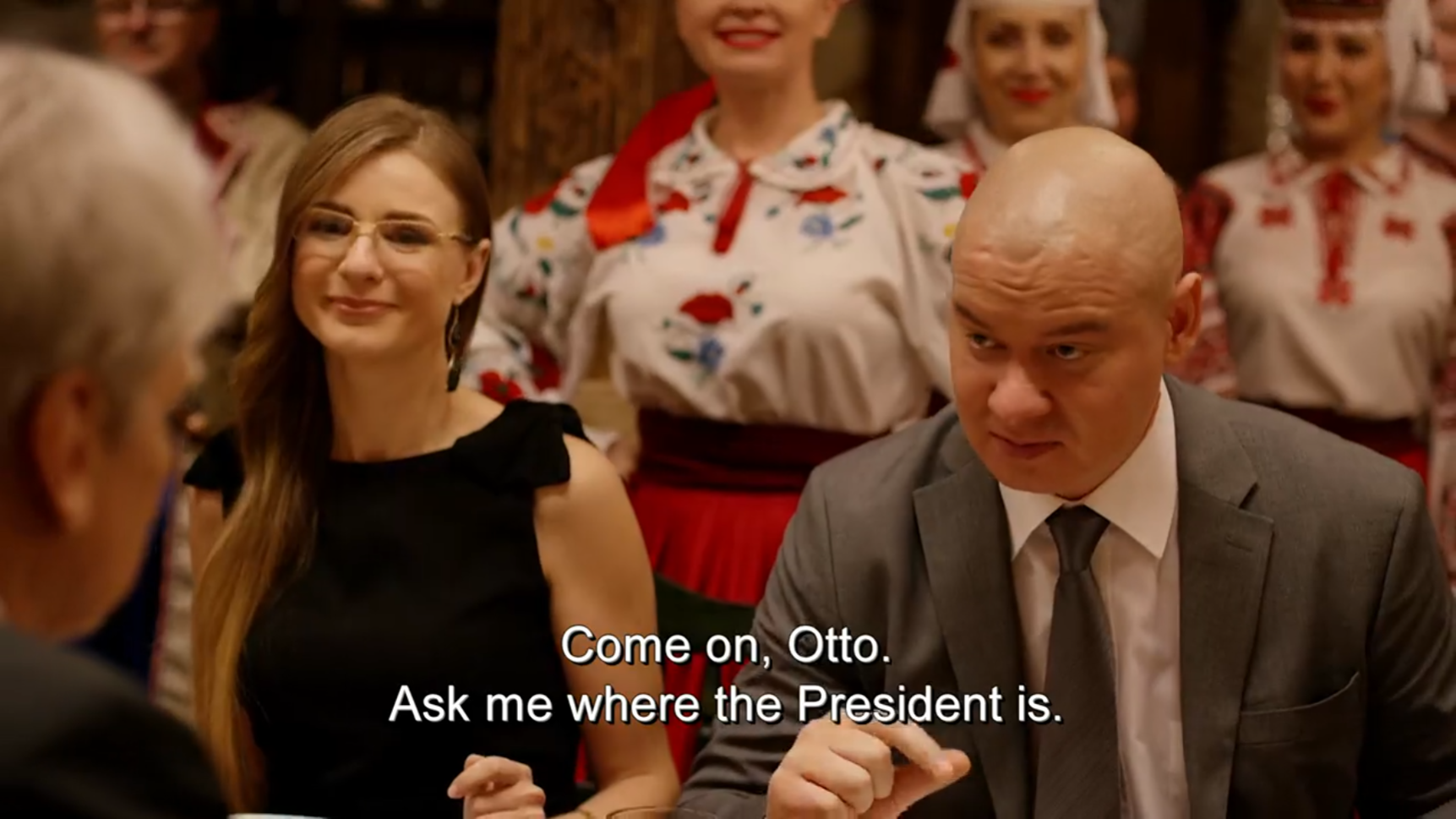
OKSANA: The traditional fourth glass . . . . . . SERGEY: Come on, Otto. Ask me where the President is. OTTO: WHERE'S THE PRESIDENT?! (Servant of the People S2E10) Those would have been hard to find, because former critics of Zelenskyy were prepared to take a bullet for him after he turned down an American offer to be evacuated, and stayed in Kyiv as the Russian army approached. We've all heard what he said . . . 'I don't need a ride, I need ammunition'. But it's funnier alongside this: 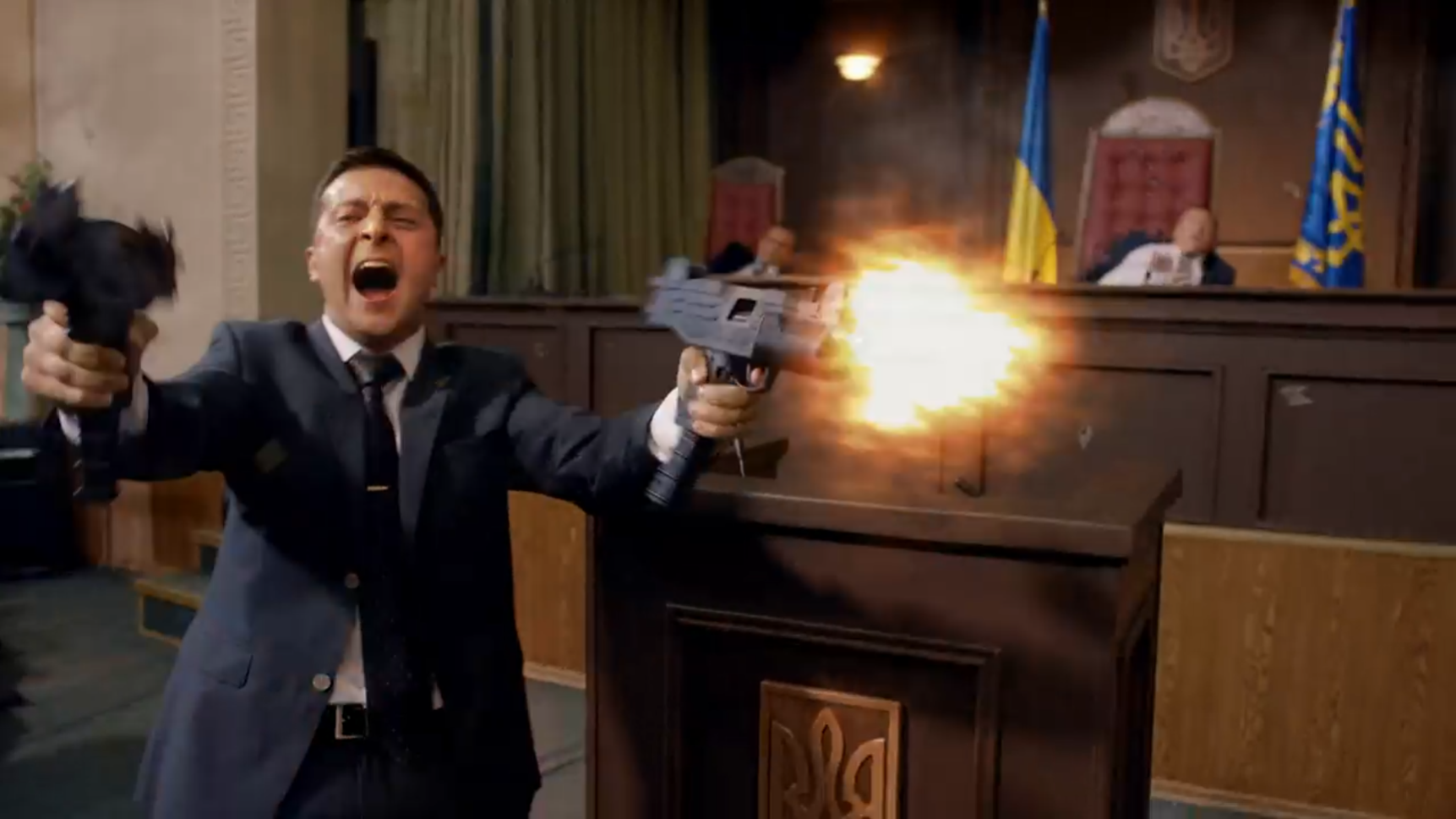
(Servant of the People S2E7) A show can tell us a lot about the audience that watches it, and Servant of the People's target audience was proud of their country. Seeing as how Zelenskyy was elected following it, there's a pretty good chance that people who voted for him — most Ukrainians who voted — are proud of their country. Their Independence Day is celebrated in some of the episodes, and there's a program of decommunisation mentioned now and again. There are no indications of a people nostalgic for their Soviet past. Moreover, whenever Russia is mentioned, it tends to be as a target of mild derision, or suspicion. When Vasya's sister, Sveta, is fishing for a job in government, she asks Sergey about jobs that might be available in the foreign affairs ministry (S1E13). To be an ambassador to most countries, she'd need to know the local language, and she doesn't seem to know any of them. Until Sergey says she wouldn't need another language for Russia, to which she says she needs a job, not exile. 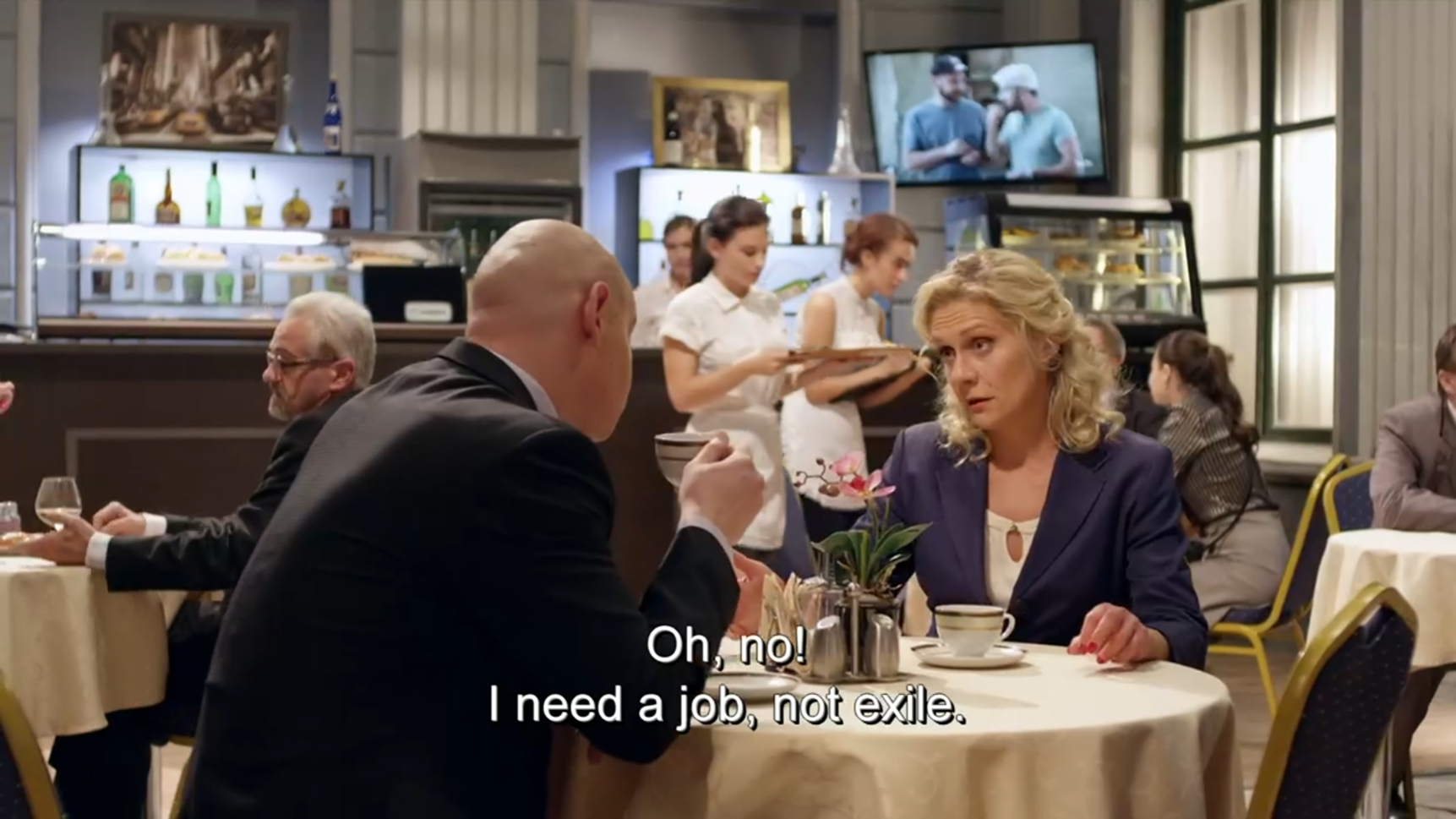
(Servant of the People S1E13) And there are more examples. Cabinet makes up a story about a meteorite about to hit Kyiv, to disperse protesters. When Vasya tells them to stop that, someone suggests they make it hit the Kremlin instead. In S1E12, a campaign is launched to raise awareness of the need to pay taxes and declare income and assets correctly. An advertisement airs that contains a line 'Who's not paying, that Russian', even though Vasya had said any ad but that one. And we could go on — so it is curious that Putin thought his army would be welcome in Ukraine. To know what was going to happen, all he had to do was watch Ukrainian TV. The guy lives in a bubble. As we know, Putin's invasion has killed tens of thousands and displaced millions of people. Putin has targeted civilian infrastructure, knocking out power in a vain attempt to weaponise winter, freeze Ukrainians and break their morale. At least, that's what it looks like the attempt is, at face value. One has to think that it might not be, because even Putin must know that such a tactic almost always fails, and has the opposite effect, of hardening resistance, which is exactly what's happening. It's been said that if Zelenskyy was to accept negotiations without the guaranteed withdrawal of Russian forces right now, there would be riots in Kyiv. The price that people have already paid is too high to accept anything less. But if you're as desperate as Putin, maybe you just try anything, including measures that almost always fail? 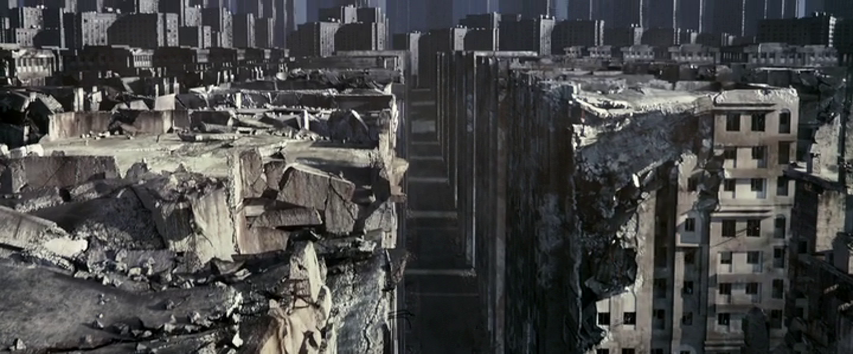
(Inception) The human tragedy inflicted by the invasion has been accompanied and aided by insidious tactics. From the beginning of the invasion, the Russians had pre-prepared lists of influential Ukrainians — leaders, journalists, prominent professionals and the like — and hunted them down. An attempt at societal decapitation in which these people, if captured, were variously interrogated, tortured, deported or killed. When it became clear that they faced a hostile population, some of whom were informers, providing coordinates to guide Ukrainian military strikes on Russian positions, the Russians tried to find, torture and in many cases kill these informers.
Of course, it often wasn't possible to know who had provided the information, so some Russian troops were told they could go after any civilians who had phones, making the violence practically indiscriminate, like so much else the Russians have been up to.
Which reinforced the resistance.
Putin's affinity for archaic imperialism tells him that to grow, blood is required, the blood of his people. It's the notion that the lives of his people can be fairly exchanged for the growth of Russia. Zelenskyy has said that the low value associated with life is how Russia fights, but also how it will lose. Putin has a problem with the expansion of NATO, as if it was expanding towards Russia in a threatening manner. The kind of expansion that NATO adopts is of a different model to Putin's. Not by conquest, but by example. By demonstrating the success of its model, countries want to join. If expansionism is possible in a world with rules, that's the way. What's interesting about this dichotomy is that it's similar to the choice that Vasya and Yuri were faced with in season 3. While Yuri wanted to coerce the independent states to rejoin Ukraine, Vasya wanted to work with what they had, and demonstrate the success of Ukraine's model so that the independent states would want to join. If the fictional Vasya understood this, then Zelenskyy understands this too. 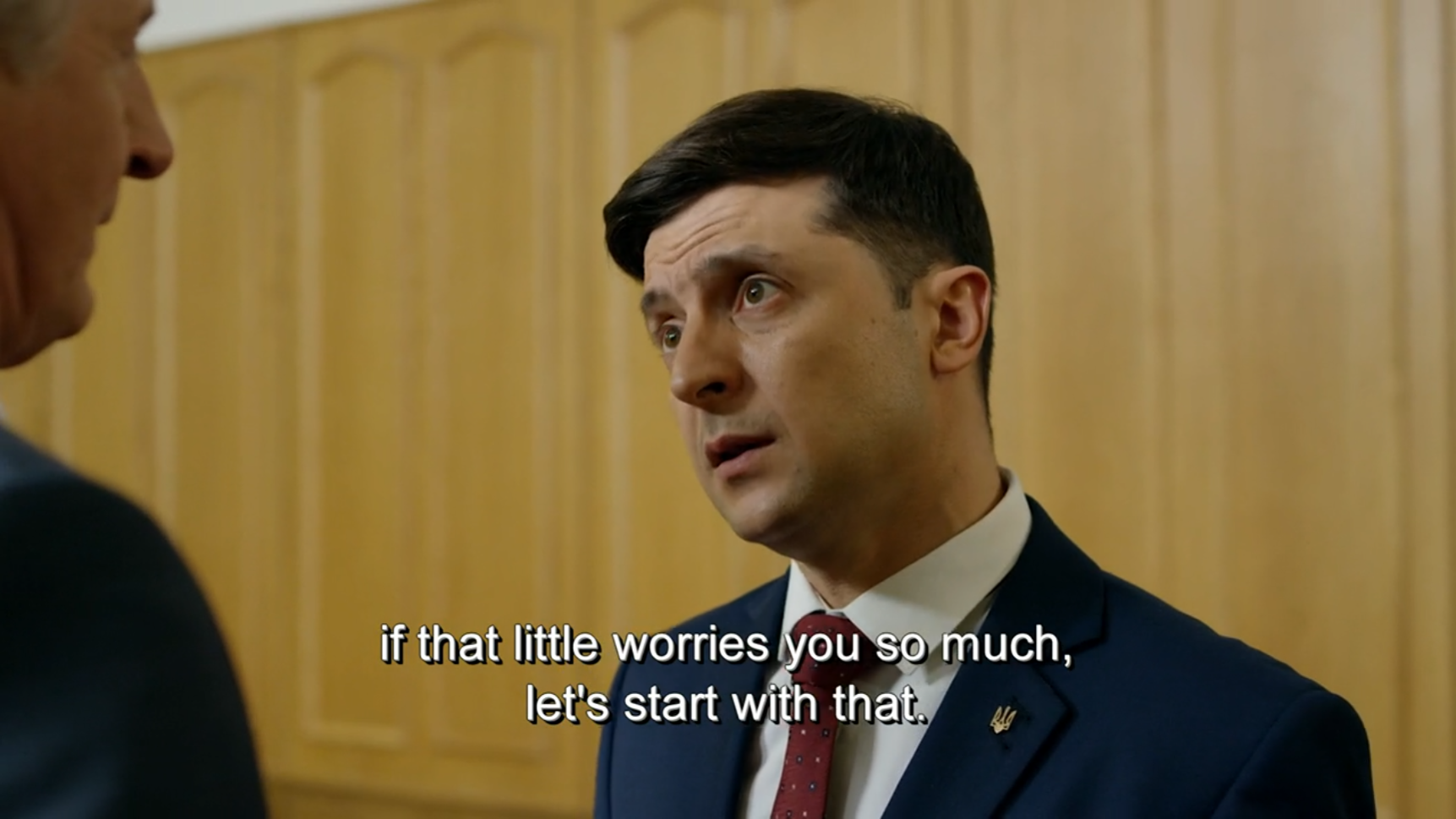
YURI: . . will not only fail to unify the country, we might as well lose the little we still have left. VASYA: Yuri Ivanovich, if that little worries you so much, let's start with that. (Servant of the People S3E3) 'I miss you more than you'll ever ever know': have you ever wanted to say something that you know would change both your life and theirs — but you can't? Maybe they're right there and you'll wish you could say those words, and for as long as you can't, it's like you've lost them. That can be the value of a life, or lives: just a few words. 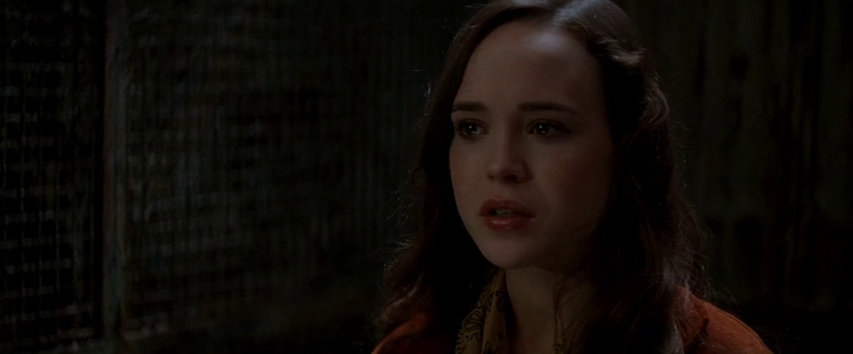
ARIADNE: These aren't just dreams. These are memories. And you said never to use memories. . . . You're trying to keep her alive. You can't let her go. COBB: You don't understand. These are moments I regret, the memories that I have to change. (Inception) 7. No Smoking Area "phoenixdk", "No Smoking Area" (Delta-Q-Delta) Favourite moments from the war so far. When a truck explosion crippled the Kerch bridge linking Crimea to Russia, Zelenskyy, still the comedian, said, 'Today was not a bad day and mostly sunny on our state's territory. Unfortunately, it was cloudy in Crimea. Although it was also warm.' Like, don't look at us, someone must have been smoking where they shouldn't have been. Followed by a cool no smoking meme. Or, er, no fire breathing. 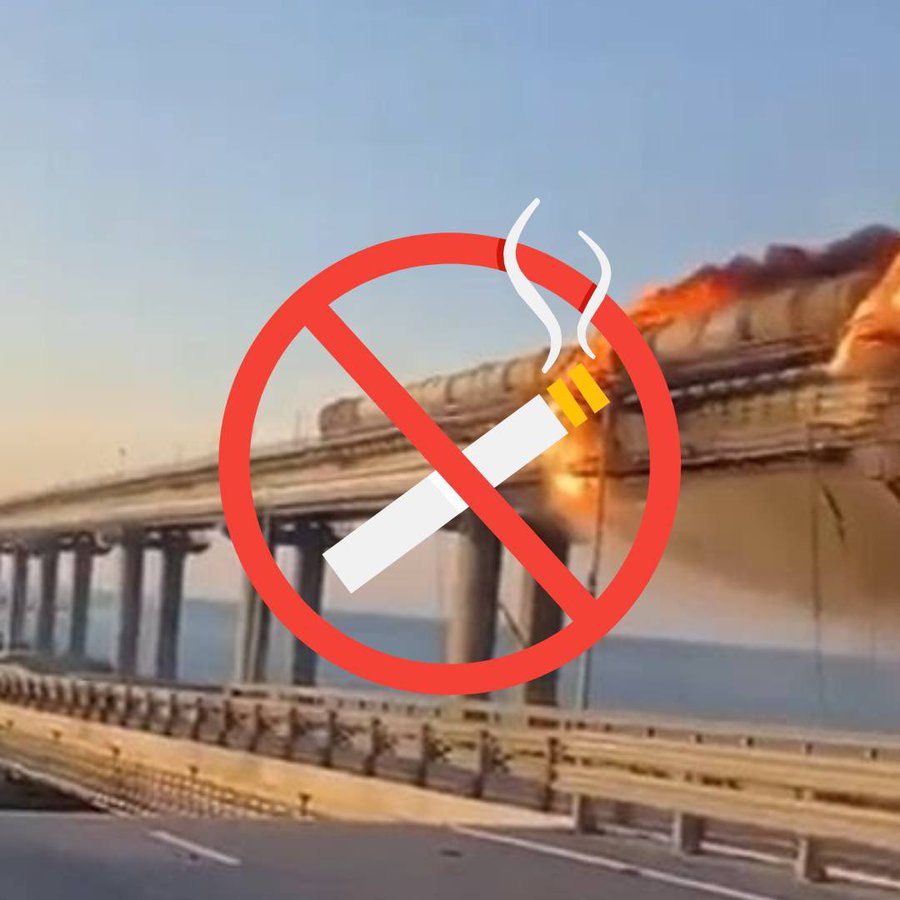
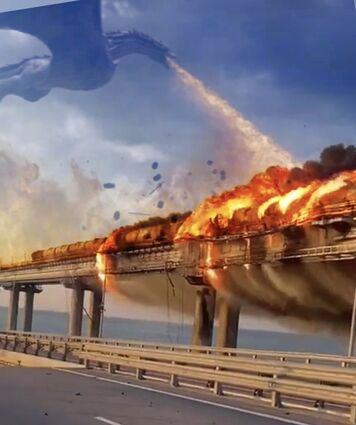
That coincided with Putin's 70th birthday. Happy Birthday, Mr President. Rough? No, this is how presidents have their birthdays celebrated in Ukraine. 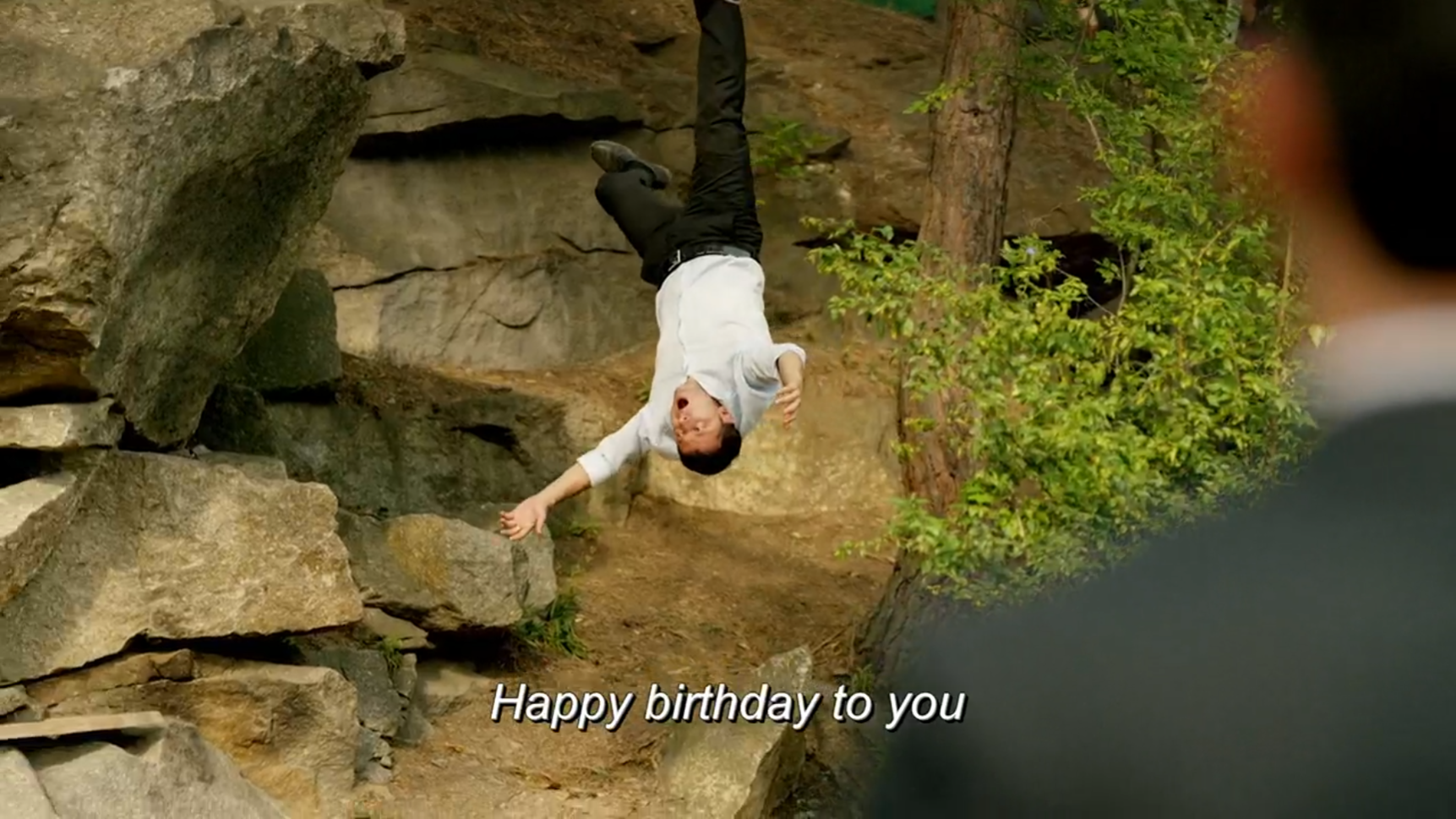
CABINET: Happy birthday, dear Vasya; Happy birthday to you! VASYA: You arseholes! (Servant of the People S2E1) I guess we've all heard about it, but it bears repetition. Earlier, on the first day of the war, the Russian guided missile cruiser Moskva hailed defenders of Snake Island, who answered with 'Russian warship, go fuck yourself.' When Ukrainian anti-ship missiles later sank the Moskva, Russian state news said it had been because of a fire on board — essentially, that the ship really had gone and fucked itself, which was almost as cool as the truth. The war is showing us what modern combat can look like. This isn't how a war between Russia and the West would be fought, because Western military planners don't count on being drawn into like-for-like contests that involve artillery duels in the style of the First World War. But without Western air power, that's how the Ukrainians have had to fight. And because the West has been supporting that fight, their own stocks are being depleted at a rate they hadn't anticipated. Arms supplies to Taiwan have been delayed. Production will need to be ramped up, both to replace spent stocks and prepare for the possibility of having to do something like this again. 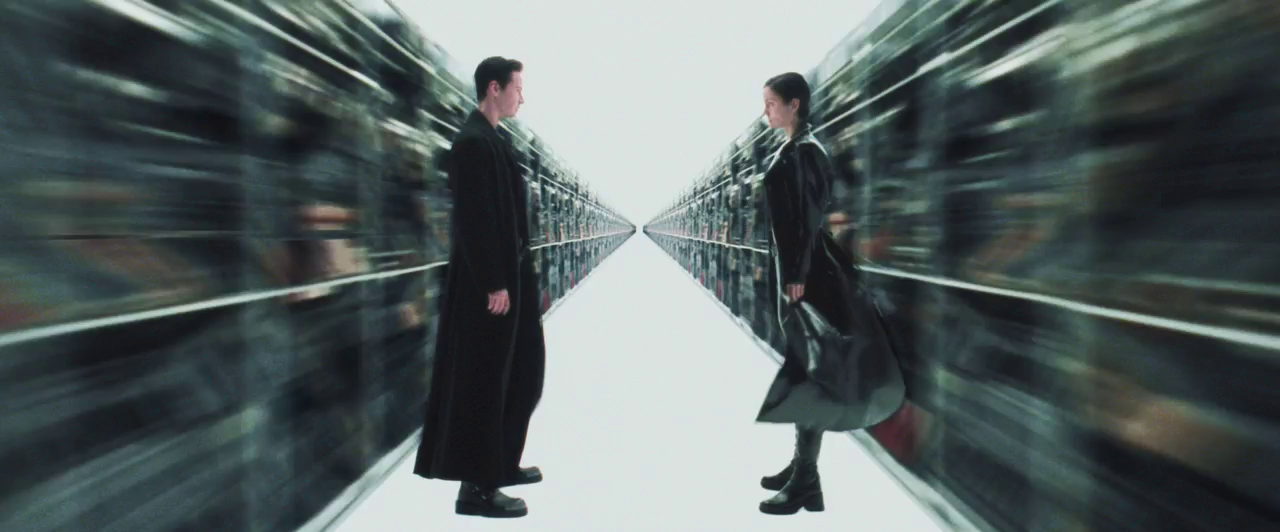
TANK: Okay, so what do you need? Besides a miracle. NEO: Guns. Lots of guns. (The Matrix) Still, the superiority of Western weapons over Russian equipment has made a difference. Javelin missiles have wrecked columns of Russian tanks, along with relatively cheap drones dropping relatively cheap explosives. Like the Turkish Bayraktar TB2. A combination of superior technologies, communication, coordination and US intelligence enabled Ukrainian forces to nimbly strike the slow Russian formations, in a pattern of dispersed warfare that kept them in the game. One lesson is that concentrated forces are more vulnerable on the modern battlefield. One of the ironies of the war is that although Putin wanted to stop Ukraine from drifting towards the West, by destroying the Ukraine that was, he is accelerating what he hoped to stop.
He actually did succeed in destroying the Ukrainian army as it was at the beginning of 2022.
That was an army that had inherited Soviet methods and equipment.
It has now been replaced by a NATO-trained army, with NATO weapons.
The same goes for infrastructure.
A lot of the Soviet-era infrastructure that Putin has destroyed will be replaced by Western equipment when Ukraine is rebuilt.
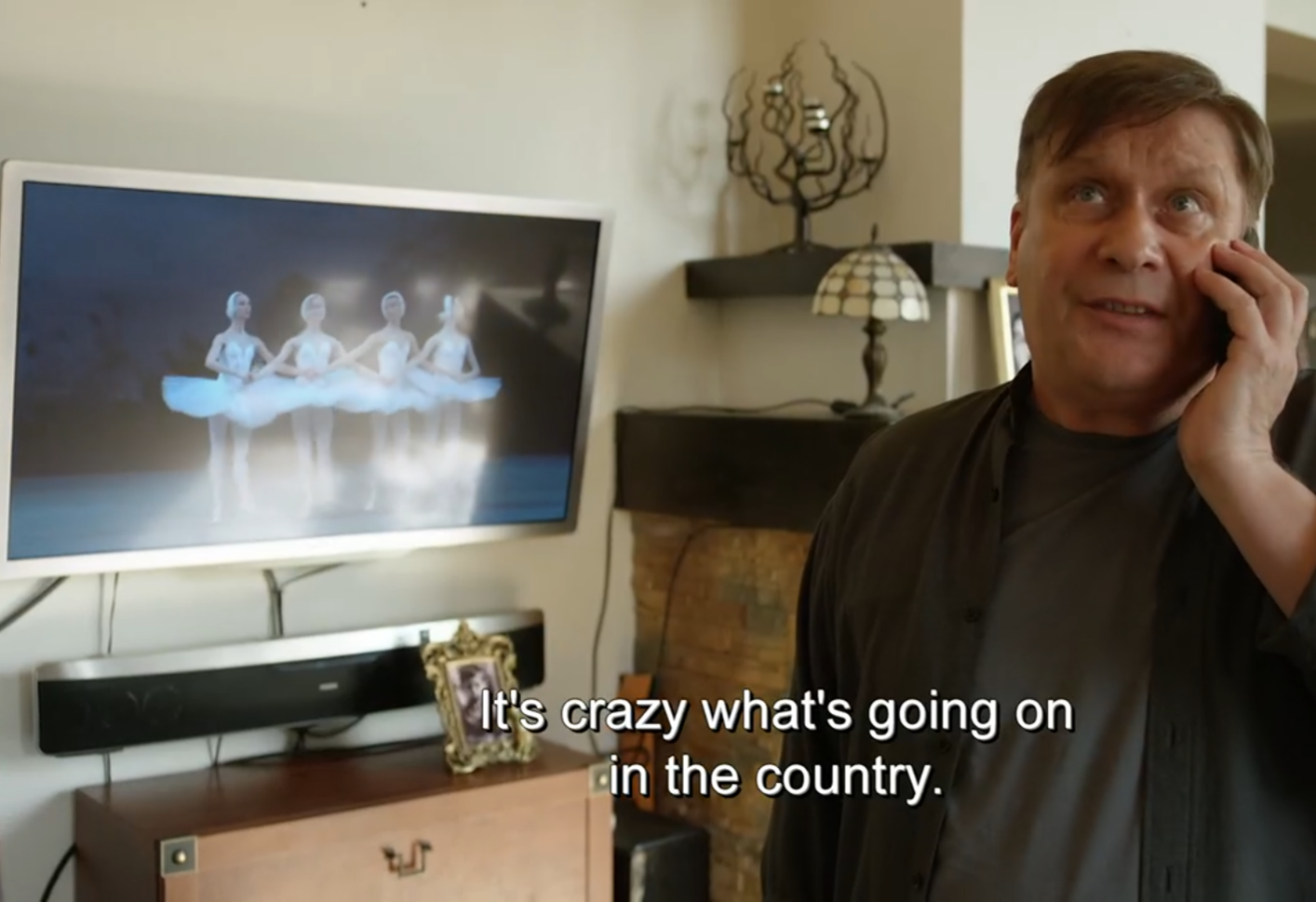
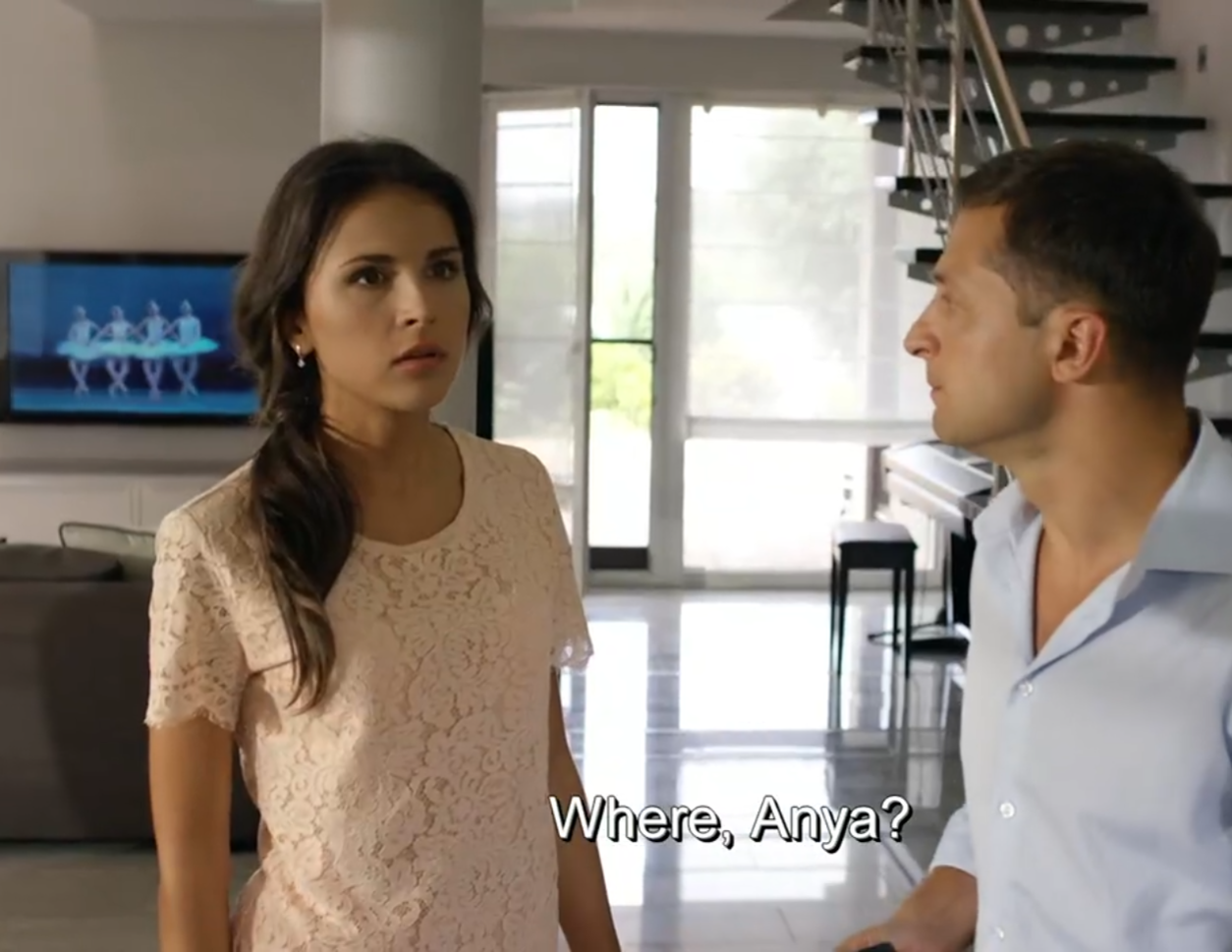
(Servant of the People S2E1) In March, staff at TV Rain, an independent Russian broadcaster resigned before airing Swan Lake. They and other broadcasters had been threatened with closure. The swans try to fly, but can't. It's part of the dictator trap, of course. Putin is one, even while he maintains the pretence of Russian democracy. He cuts himself off from sources of information he doesn't control, because they spread information he doesn't like. Eventually, his state apparatus, which he controls, becomes his only source of information, along with advisers who agree with him. So in a frighteningly real way, he essentially becomes his only source of information. He's trapped in his own dream. Without the right information, he becomes more likely to miscalculate, to take risks he can't control. Dictators take risks because it's in their DNA. That's how they became dictators in the first place. He dreams of restoring the Soviet Union, of the expansionist tsars and Stalin, and of a people who are prepared to suffer for his dream. 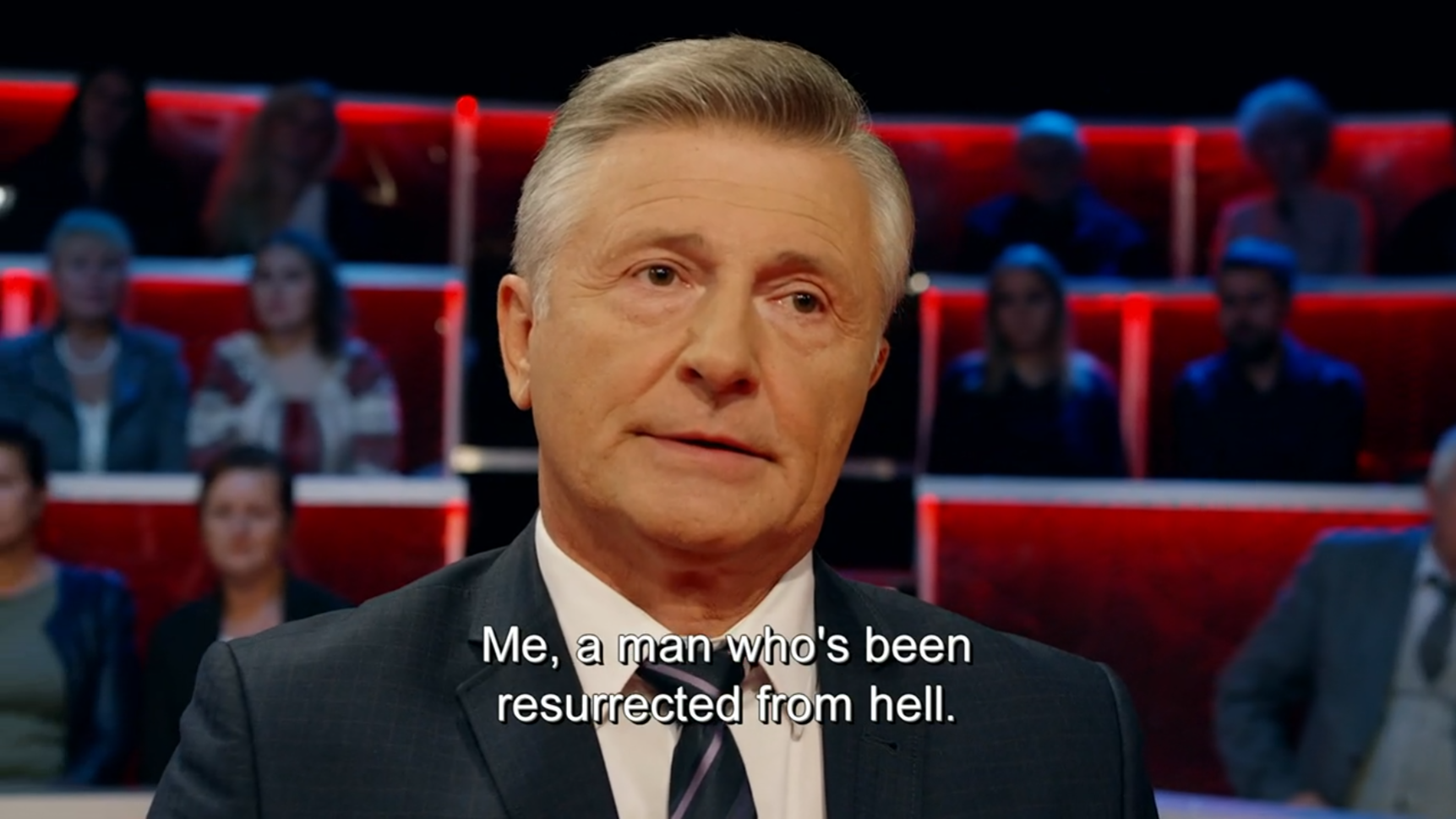
YURI: You are a country of incredible masochists. . . . It's ironic that I'm telling you this. Me, a man who's been resurrected from hell. . . . When I see all this, I really want to die again. (Servant of the People S2E23) And he could almost be forgiven for that presumption, because Russia has such a colourful history. The people who defeated Napoleon, and Hitler, at such monumental cost. To bring them along, though, he needs his people to be even more deluded than he is — a dream within a dream. 
COBB: . . . to remind you of something. Something you once knew. That this world is not real. (Inception) 9. A Better Future Please make sure we get tomorrow All this pain and all this sorrow I demand a better future Or I might just stop needing you - "A Better Future" (Heathen) 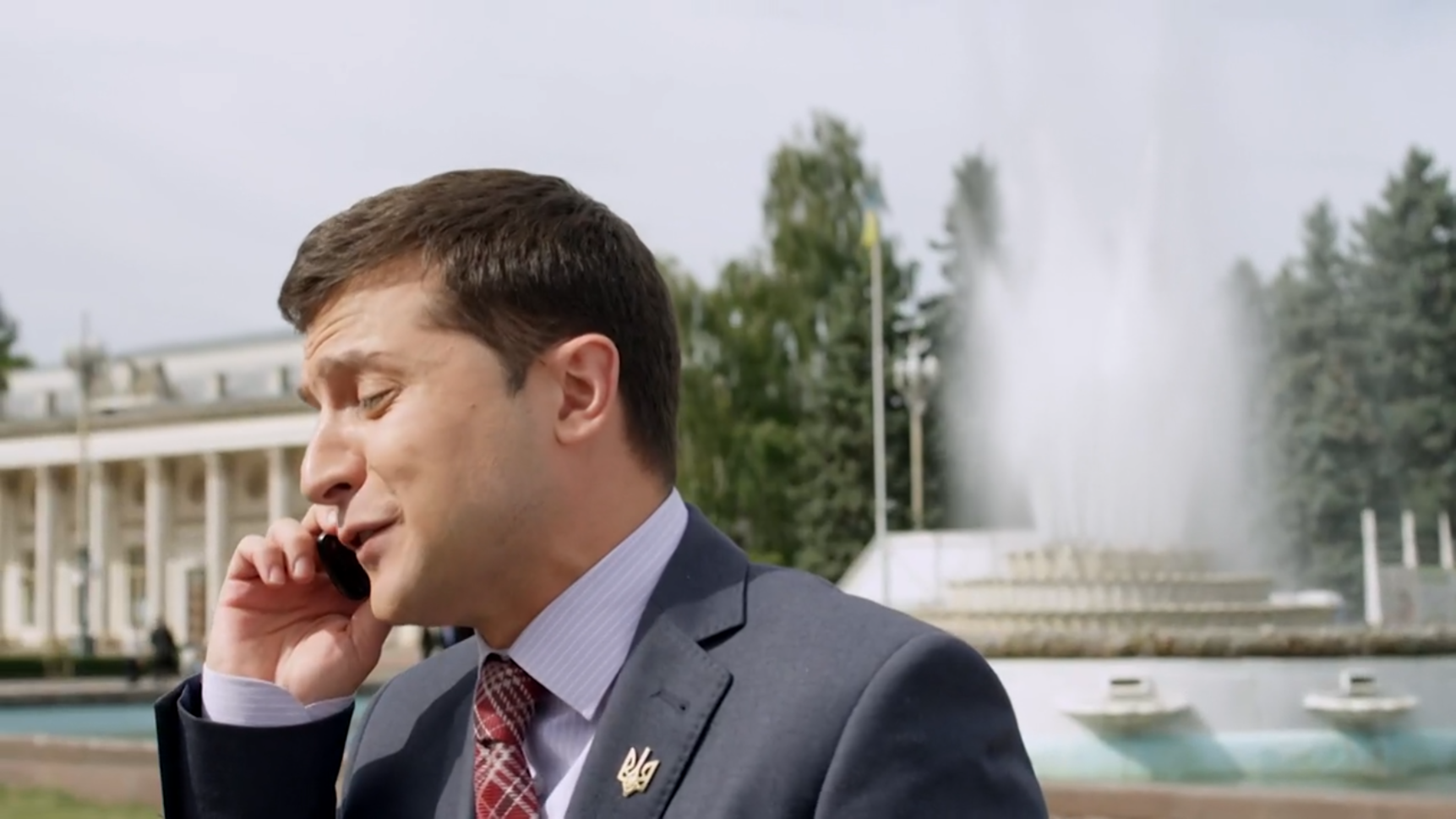
ANGELA MERKEL: We decided to take your country to the European Union. VASYA: . . . I'm so happy. Yes! . . . All the Ukrainians, and all of our country, we've been waiting for this so much time (sic). (Servant of the People S1E18) In S1E18, Vasya is called about admission to the European Union and is happy about it. The momentum towards Europe seems unquestioned throughout Servant of the People. Vasya wants to improve roads, and shows his infrastructure minister foreign examples (S1E14), comparing them with Ukraine's roads. These aren't Russian examples: they are from Poland, Slovakia, Belarus, China and Pakistan. He says examples from the US, Germany or Italy would make cruel comparisons. The party Vasya leads leans towards Europe, evidenced by a European Union flag at the front of their campaign bus (S2E22). In season 3, prison standards are compared with what can be expected in Europe, and Vasya's friends don't try to help imprisoned Vasya by visiting Moscow, they go to Brussels (I think . . . definitely somewhere in Western Europe). It isn't just an affinity for Europe that is evidenced, but also an estrangement from Russia. There are hints of tension in eastern Ukraine with Russia, in season 3, but the most overt expression of this estrangement is in S1E23, in which Vasya "communes" with Ivan the Terrible, the first tsar of Russia. 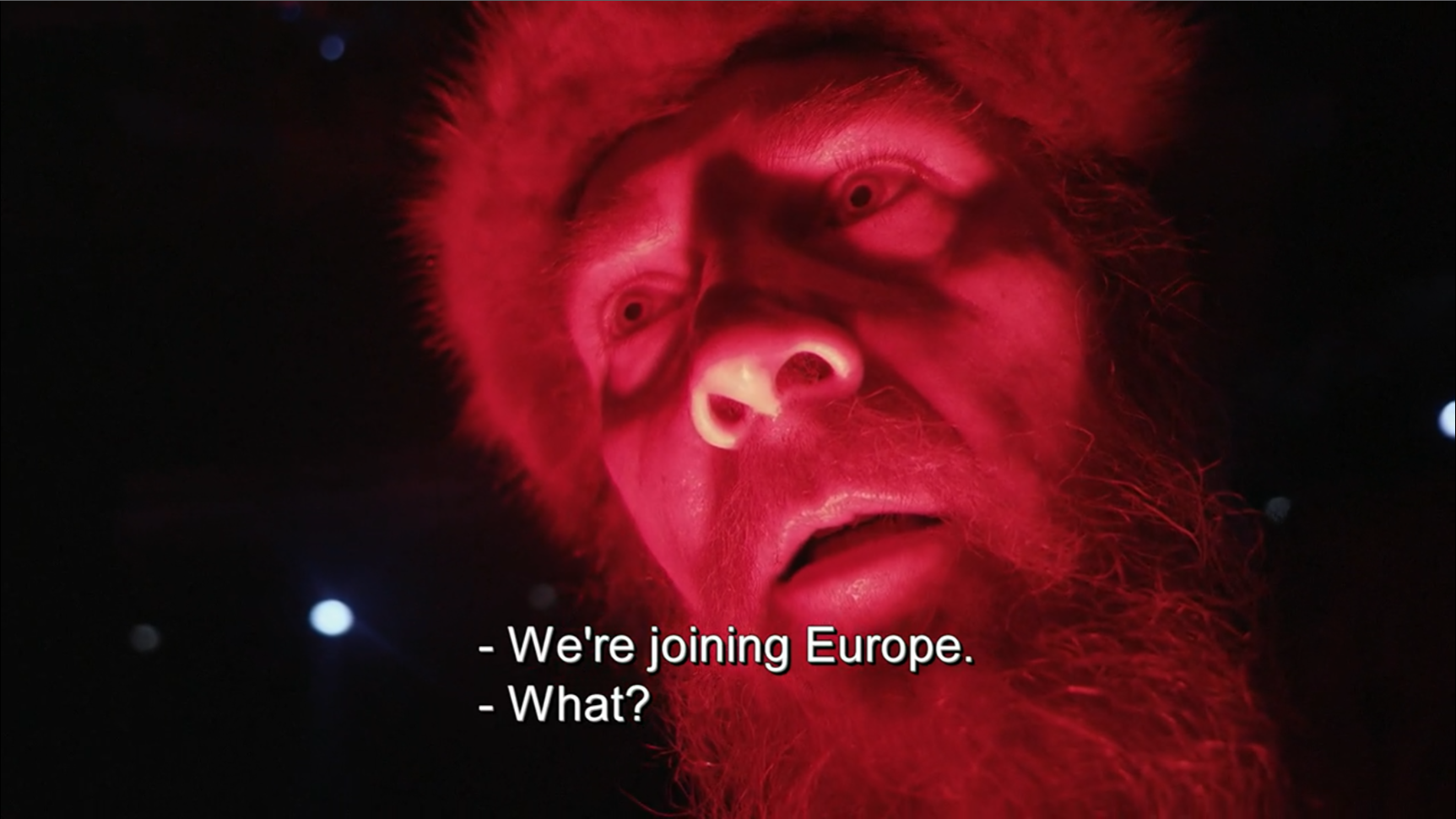
VASYA: Thanks, but we don't need saving. IVAN THE TERRIBLE: Why not? VASYA: We're joining Europe. . . . IVAN: But we're Slavs. We're blood brothers! (Servant of the People S1E23) Ivan finds this difficult to accept, and loses it. A little like Putin over Ukraine's inclination to join NATO. The show evidences a Ukraine that wants to leave anything like a Russian orbit, but Putin's invasion made the cost of that escape very high, and the trip an uncertain one. 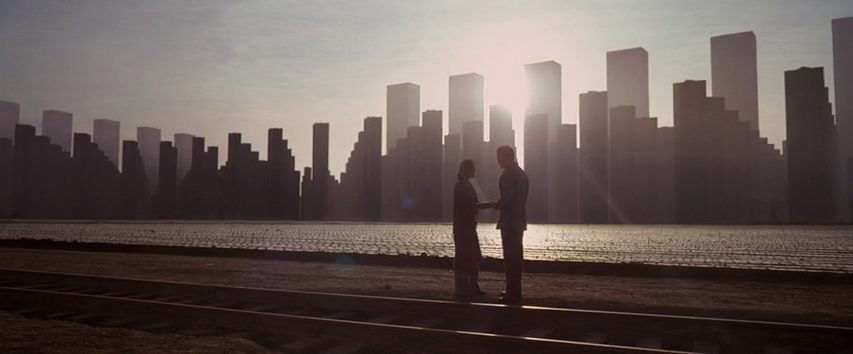
MAL: . . . that death was the only escape. . . . COBB: You know where you hope this train will take you. But you can't know for sure. (Inception) 10. Time Hans Zimmer, "Time" (Inception soundtrack) There will be no tomorrow Then you sigh in your sleep And meaning returns with the day - "How Does the Grass Grow?" (The Next Day) Zelenskyy mixes it up when speaking to foreign parliaments, and adapts his message for his audience. When he addressed the Australian parliament, he mentioned that the giant Antonov plane Mriya had visited Australia. Mriya (Ukrainian for "dream") had been destroyed in the invasion, but Zelenskyy said that although their dream plane had been lost, Ukraine's dream could not be destroyed. When Albanese visited Kyiv later in the year, he was given a model of Mriya. We have an idea of what Ukraine's dream is, or at least what Zelenskyy's dream for Ukraine is. In S3E1 of Servant of the People, in a history lesson set in 2049, Ukraine is described as enjoying a decent standard of living, in the G20, one of the leading developed economies, its debts are paid off, having achieved true independence. All that seems a long way off, but given Zelenskyy's ability to turn as much of his dream, Servant of the People, into reality, as he already has, I wouldn't bet against it. 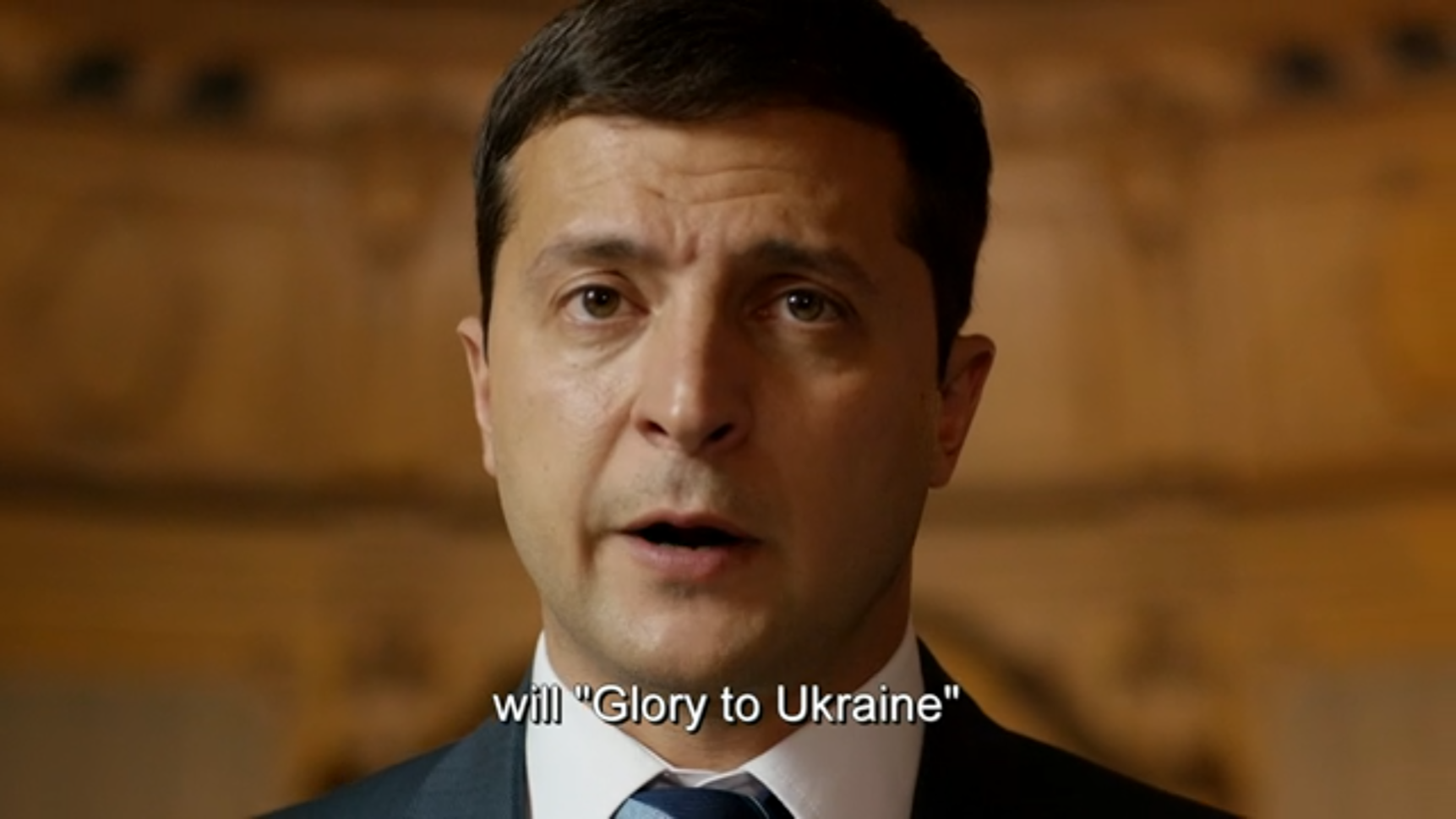
VASYA: You can't build Ukraine up with talk alone. When we stop . . . dividing Ukrainians into "us" and "them", and unite instead, only then will "Glory to Ukraine" [Slava Ukraini] be heard not just here, but around the world. (Servant of the People S2E13) We've seen some of the possible reasons for Alex Pian's reference to Inception. My favourite is the Russian army as an oncoming train, and Ukraine's struggle as an escape from a dream. 
COBB: And it doesn't matter. Now tell me why! MAL: Because you'll be together! (Inception) And meaning returns with the day.
Slava Ukraini.
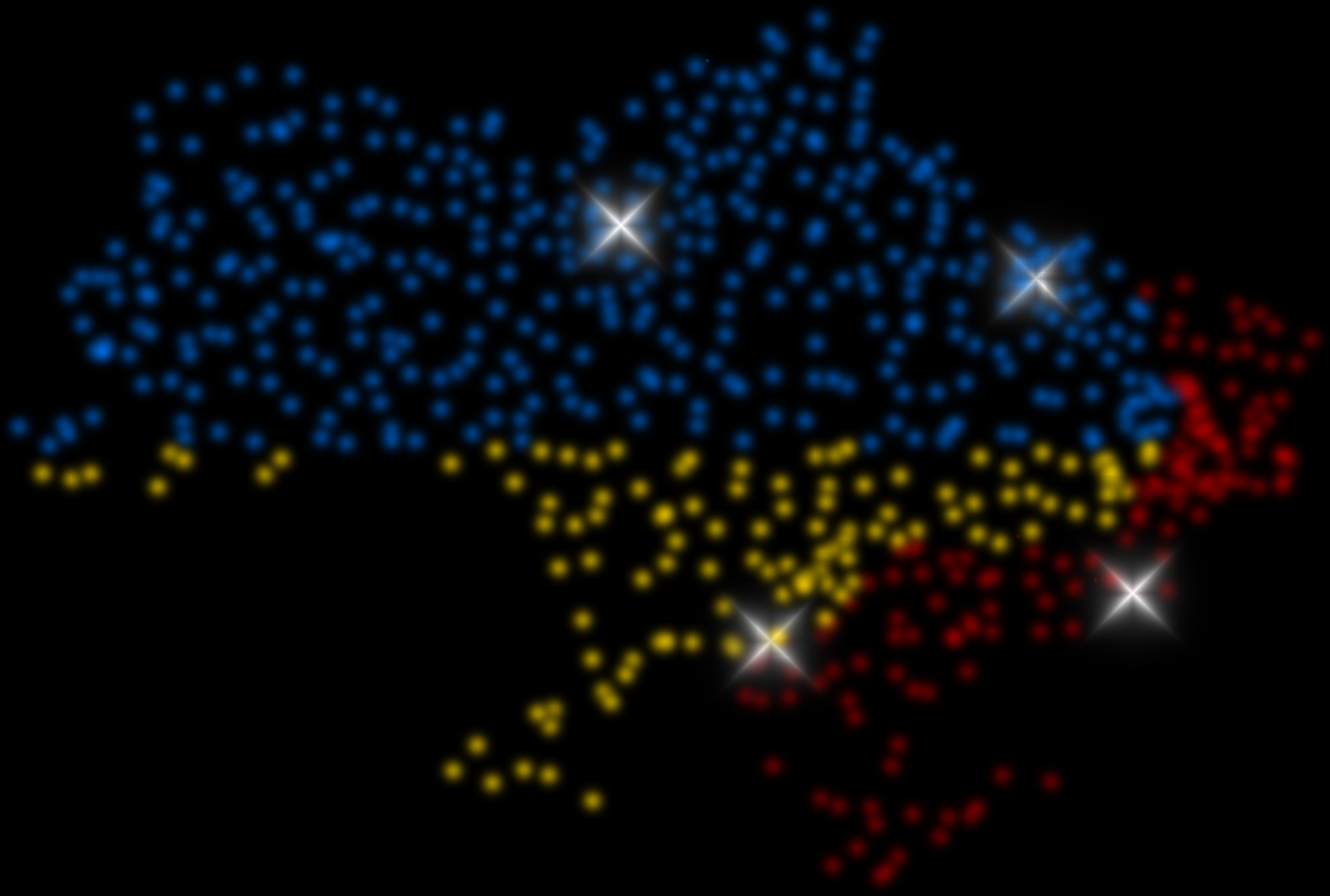
Title Image: A map of Ukraine, with 630 towns rendered with markers in the Ukrainian colours, or in red if occupied by Russian forces at the end of 2022. The stars mark the positions of Kyiv, Mariupol, Kharkiv and Kherson. The markers were produced with the same code that made the background image for this page. They were placed by overlay on an image by Viewsridge at Wikipedia, CC BY-SA 4.0. Following illustrations: still from The Dark Knight; still from Inception; still from the season 2 version of the Servant of the People introduction; still from Servant of the People S1E11; stills from Servant of the People S3E1; still from Servant of the People S2E14; still from Inception; still from Inception; still from Servant of the People S1E4; still from Inception; still from Servant of the People S2E10; still from Servant of the People S2E7; still from Servant of the People S1E13; still from Inception; still from Servant of the People S3E3; still from Inception; images from Kerch bridge commentary; still from Servant of the People S2E1; still from The Matrix; stills from Servant of the People S2E1; still from Servant of the People S2E23; still from Inception; still from Servant of the People S1E18; still from Servant of the People S1E23; still from Inception; still from Servant of the People S2E13; still from Inception. **I only know about this from Chris O'Leary's piece on this song. What a catch! ***The music backing the bushmasters is "Marauder" by Tigerblood Jewel. Earlier (2021: Sunday) Later (2023: Scary Monsters (and Super Creeps)) |